
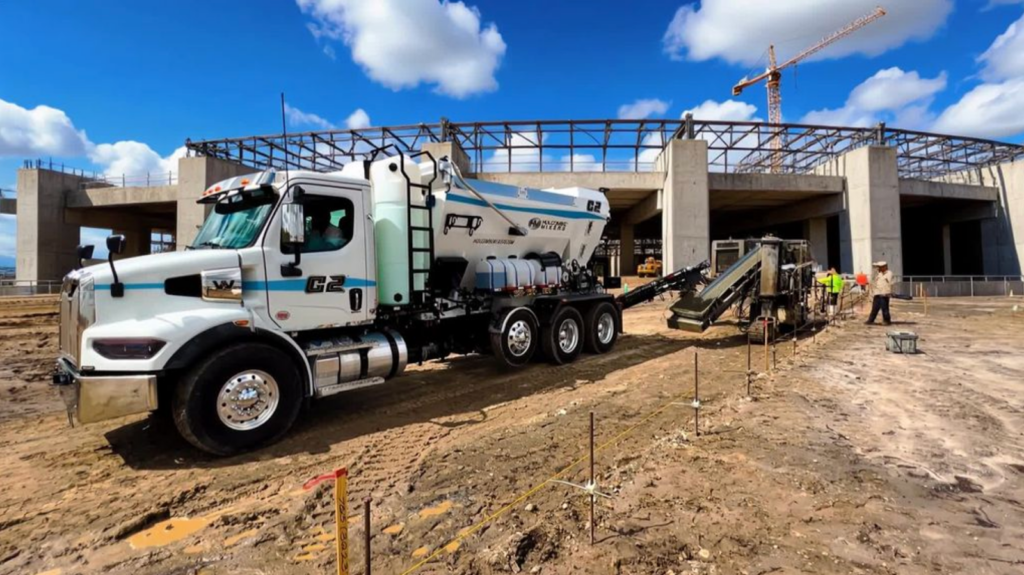
Across infrastructure markets, contractors and municipalities are questioning a long-standing assumption: concrete must come from a batch plant.
That model worked when schedules were looser, plants were closer, and delivery variability carried less downside. Today, the jobsite is less forgiving. Data center campuses move on compressed timelines. Utility corridors stretch beyond traditional supply zones. DOT and municipal contracts come with strict inspection windows and documentation requirements.
In that environment, delivery timing, mix consistency, and cost predictability directly affect margin and public accountability. As projects get more complex, dependence on third-party ready-mix becomes harder to justify.
Data Centers Exposed the Weak Point First
Large data center builds operate on compressed schedules with overlapping trades and phased inspections. Concrete placements often include:
- Flowable fill for conduit encasement
- Structural equipment pads
- Slab sections tied to mechanical installations
- Corrective pours between major phases
Each placement feeds the next trade. When delivery slips, labor costs increase immediately and sequencing becomes unstable.
Traditional ready-mix is structured around assumptions made at the plant: expected transit time, expected jobsite conditions, expected unloading pace. Once the drum leaves the yard, those assumptions are fixed. Traffic delays, site congestion, and temperature swings continue to affect the material in transit. By the time the truck arrives, contractors are often adjusting around concrete that has already begun changing.
On high-spec projects, that reactive posture introduces risk.
For mid-sized civil contractors bidding $10M–$100M scopes, that risk directly affects win rates and margin protection.
Utilities and DOT Work Face the Same Constraint
The same pressure appears in utility and transportation work.
Utility contractors frequently open, inspect, fill, and close trench sections within a single shift. Delays increase labor exposure and traffic control costs. Smaller placements still require spec compliance, yet ready-mix minimums routinely exceed actual need.
DOT and municipal projects add documentation requirements and tight inspection coordination. When deliveries arrive late or inconsistent, crews absorb the impact and public timelines shift.
Across these verticals, the pattern repeats:
- Delivery timing determines crew productivity
- Mix adjustments occur after problems surface
- Over-ordering becomes routine to avoid short loads
- Cost per yard drifts upward through waste and standby time
The issue is structural. Batching begins away from the placement environment, under conditions that may not match the field.
What Changes When Production Moves On Site
Volumetric mixer trucks shift production to the jobsite. Raw materials remain separate during transport and combine at the point of discharge, and hydration begins under the same environmental conditions in which the concrete will be placed.
That operational shift produces measurable results:
- Crews pour when ready rather than when deliveries allow
- Slump is adjusted in real time based on actual site conditions
- Quantities match true yardage requirements
- Production pauses do not create waste
For contractors building a self-performing concrete division, this shift improves uptime and stabilizes internal cost per yard, and it reduces exposure to plant price hikes and delivery bottlenecks.
For municipal buyers, it ensures spec compliance while generating clear documentation at the time of production, supporting DOT and grant-backed accountability.
Production Capacity Has Caught Up With Demand
Earlier volumetric systems were often viewed as limited to smaller placements. Modern high-output platforms support large-scale infrastructure work.
Holcombe’s volumetric mixers are capable of producing up to 100 cubic yards per hour, supporting pump-fed slabs, bridge decks, and continuous industrial pours without slowing placement operations.
That production rate allows contractors to replace plant dependency on serious infrastructure projects rather than supplement it.
For growing civil firms, that output becomes the foundation of a scalable concrete division.
The Technology That Makes Control Practical
Production speed alone does not protect margin. Mix consistency determines rework risk and inspector approval.
Holcombe’s WaterSmart™ slump control system maintains consistent moisture control across production speeds and changing weather conditions.
For contractors, this reduces variability that leads to callbacks and corrective pours. And for municipalities, it supports repeatable spec compliance on public works and DOT projects.
High-output capability combined with precise slump control is what turns a volumetric mixer truck into a reliable primary solution rather than a backup option.
The Financial Drivers Behind the Shift
Operational control has a direct impact on financial performance. Dependence on ready-mix introduces recurring costs through delayed deliveries, idle labor, standby, and more. When production moves on site, those variables shift from external constraints to internal control, aligning cost per yard more closely with raw material pricing and giving contractors greater scheduling flexibility on remote and time-sensitive bids.
This reflects Concrete Independence: transferring scheduling, quality, and cost control from the plant to the contractor or municipality. When production moves on site, crews pour when they are ready, inspections align with actual progress, and remote or phased work no longer depends on plant availability or traffic conditions. Mix adjustments happen under real field conditions, with slump, yield, and production rate managed at the chute rather than assumed miles away. That reduces rework exposure for contractors and strengthens documentation and compliance for DOT and grant-funded municipal projects.
Companies such as Lucky Dog have demonstrated how self-performing production can scale into a full concrete division within a year, turning supply control into a growth lever rather than a constraint.
Built for Field Conditions and Long-Term Partnership
For on-site production to replace ready-mix in demanding applications, uptime and service responsiveness must match output capability.
Holcombe supports its systems through factory-direct service, U.S.-based technical support, and application guidance. Municipal buyers benefit from documentation support aligned with DOT and grant compliance requirements. Contractors gain direct access to engineering and calibration expertise without dealer-layer delays.
While many manufacturers rely on dealer networks to move equipment, Holcombe builds long-term partnerships focused on uptime, mix accuracy, and operational growth.
Take Control of Your Concrete
Across data centers, utilities, and public infrastructure work, contractors and municipalities are eliminating external bottlenecks wherever possible. Concrete production remains one of the largest controllable inputs in any project—and one of the most impactful to margin, compliance, and schedule performance.
Holcombe volumetric mixers are built for organizations ready to take that control seriously. With high-output capability up to 100 yd³/hr, integrated WaterSmart™ slump control, and factory-direct support from U.S.-based experts, Holcombe systems are designed to support real infrastructure work—not just supplement it.
If your upcoming projects include high-spec, phased, or remote placements, now is the time to evaluate what on-site production would change inside your operation.
Talk with a Holcombe Expert or run the ROI Calculator today.