
Continuous Pours Work Best When You Control the Concrete
Continuous pours rarely fail because your crew isn’t ready. They fail when concrete doesn’t arrive—or arrives out of spec. If you run pump-fed slabs, long trench work, or multi-day foundations, you’ve seen it: the pump is primed, the forms are set, and then the schedule slips. A hot load shows up, water gets added to chase slump, and the window for a clean, continuous placement starts to close. If your 2025 plan includes long placements, this is the year to build true concrete independence into your jobs.
The Real Risk Isn’t Placement—it’s Supply
Once a continuous pour starts, the rules are simple: keep the pump fed and keep the mix on spec. Ready-mix adds variables you can’t control—production pauses, aging drums, and slump drift—so you end up managing arrivals instead of managing quality. That gap between “scheduled” and “fresh” is where joints, callbacks, and margin erosion creep in.
Volumetric Changes the Critical Path
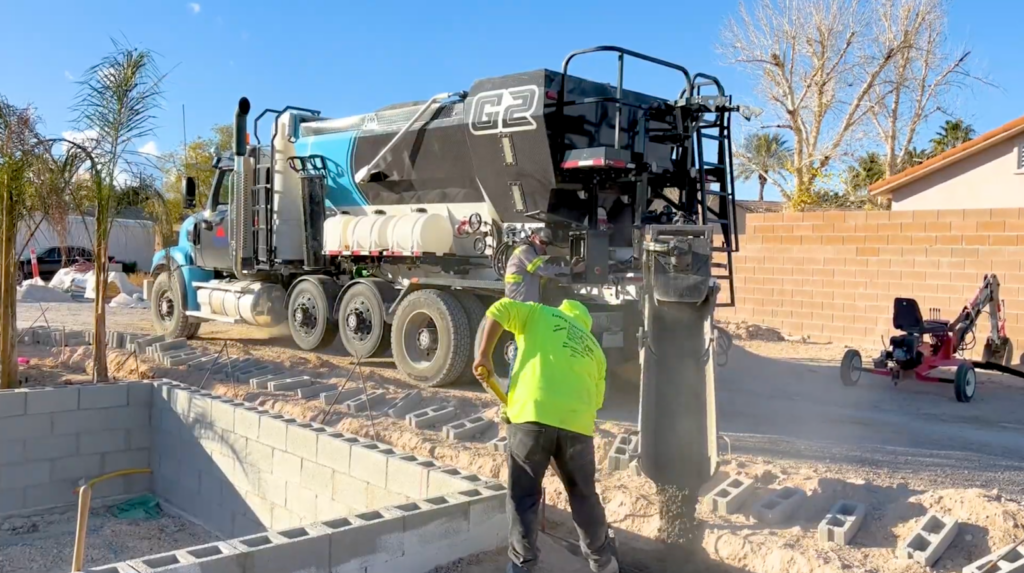
Volumetric mixers remove the batch plant from your bottleneck. You produce concrete on site and on demand, so production starts when the pump is ready, pauses when crews need to regroup, and restarts with fresh material—never reworked. For continuous pours that means:
- No hot loads mid-placement
- No forced water additions to “fix” slump
- No gaps that create cold joints
- No wasted yards when production pauses
You pour at the pace the job demands—not the pace the plant allows.
Built for Continuous Production—not Occasional Pours
Holcombe mixers are designed for crews that can’t afford mid-pour surprises. The G2 delivers up to 100 yd³/hr of continuous production—enough to keep large pumps fed on high-demand placements. Just as important, that output is controlled. WaterSmart™ helps maintain consistent slump as moisture, material, temperature, or production rate changes, so operators stop chasing the mix and focus on placing it. When jobs require multiple designs—say footing to slab—true dual-bin systems let operators switch mixes on site without flushing or contamination. On big placements, one Holcombe truck can often replace two units around the pump, cutting congestion and labor.
What Actually Makes a Continuous Pour Succeed
Contractors who excel at long placements don’t rely on luck—they rely on control:
1) Spec compliance and documentation
On-site production makes it straightforward to log every critical value—slump, yield checks, temperature, admixture dose, time stamps—and tie those to load IDs and pour segments. That record keeps inspectors satisfied and protects your margin if questions arise later.
2) Weather strategy that travels with you
Hot day? Adjust moisture and pace without risking set time. Cold snap? Dose accelerators, protect aggregate staging, and maintain target slump without over-watering. When the environment changes, you adapt on the truck—not at a remote plant.
3) Admixture control for pace changes
When you need to slow for reinforcement or speed up to match pump rhythm, on-truck dosing and WaterSmart™ stabilize the mix so your crew isn’t fighting slump drift or inconsistent finish characteristics.
4) Layout that prevents bottlenecks
A simple site plan goes a long way: clear loader lanes to the bins, protected water/admixture access, a straight pump approach, and safe turnaround. Fewer vehicles clustered at the pump equals smoother choreography and lower risk.
5) Phased mix changes without downtime
Dual-bin capability lets you move from footing to slab or base to topping without flushing. You keep the pump fed while the crew transitions, and the documentation trail shows exactly when and how the mix changed.
Why January Is the Right Time to Make the Move
January is when schedules lock, budgets finalize, and equipment plans get real. If continuous pours are on your 2026 slate, now is the time to remove the biggest variable—concrete supply. Starting in January means:
- Equipment ready before peak season. Lead times and upfitting happen off the critical path.
- Crews trained before calendars tighten. Operators can practice dialing slump and managing output without job-site pressure.
- Full-year ROI. Every yard you place on your schedule compounds across the entire season.
- Bid with confidence. Estimating improves when production is under your control.
Talk to a Holcombe Specialist
Get in touch today to receive a job-specific plan for your next continuous pour. Our expert team will review your pump capacity and target output, and walk through lead times, training, and support—so you can pour on your schedule, not someone else’s.
Talk to a Holcombe specialist to review your upcoming pours and see exactly what changes when you control the concrete.