
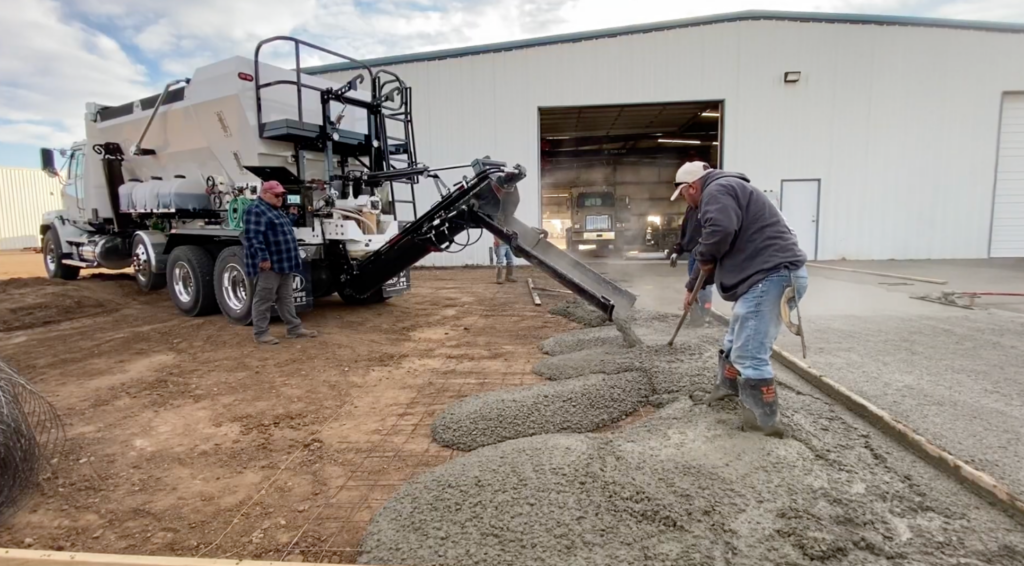
Most contractors don’t compare volumetric vs. ready-mix until something forces the issue.
A delayed truck, inconsistent mix, or a crew waiting on concrete is usually where the conversation starts.
Sometimes ready-mix works exactly as planned. Other times, small disruptions—timing, access, or changing conditions—start to impact the job.
The difference comes down to how each method handles those variables.
Here’s how each approach performs—and where the differences start to matter.
Scheduling Starts at Different Points
With ready-mix, production begins at the plant. Water is added, the mix is activated, and the load is dispatched on a fixed timeline. From that point forward, the job has to align with the delivery. If everything holds—crew readiness, access, inspection timing—it works. But when something shifts, timing becomes harder to manage.
You typically see it play out in a few ways:
- Deliveries arrive early and placement gets rushed
- Deliveries arrive late and crews sit idle
- Missed windows push the schedule into the next load cycle
Volumetric mixing moves that starting point to the jobsite.
Production begins when the crew is ready, not when the truck leaves the plant. If prep takes longer than expected, nothing is lost. If placement pauses, production pauses with it.
That shift removes the need to coordinate the job around delivery timing. And that’s a big reason why contractors are ditching ready-mix.
Mix Conditions Don’t Stay Fixed in the Field
Ready-mix is proportioned based on expected conditions—haul time, temperature, and placement rate. Those assumptions can be accurate at dispatch, but they don’t always hold by the time the concrete is placed.
As conditions change, the mix can change with them:
- Heat accelerates set time
- Moisture varies across materials
- Placement slows around congestion or sequencing
Adjustments often happen after the load arrives, which introduces variability from one placement to the next.
Volumetric systems mix on site, under the same conditions where the concrete is being placed.
That allows:
- Real-time slump adjustment
- Consistent yield across changing conditions
- Each yard to be produced as it’s needed, not ahead of time
The result is less reliance on assumptions made before the job starts.
Yardage Is Estimated vs. Produced
With ready-mix, ordering is based on estimated quantities. To avoid running short, most crews build in a buffer. That usually means extra material at the end of the pour, along with the time and cost of handling it.
Running short creates a different problem—waiting on another load, often at the worst possible time in the sequence.
Volumetric production removes that decision point.
Concrete is mixed as placement progresses:
- Production stops when the job stops
- Additional material can be produced immediately if needed
- No unused concrete is left in the truck
This ties material usage directly to what’s actually placed, instead of what was ordered in advance.
Distance Introduces Risk Before the Job Starts
Ready-mix performance is closely tied to distance from the plant. As haul time increases, so does exposure to traffic delays, volatile weather conditions, and changes in workability during transit.
Access can add another layer of complexity, especially on tight or remote sites where staging multiple trucks is difficult.
Volumetric mixer trucks transport raw materials and mix on arrival.
That changes how distance affects the job:
- Travel time does not impact curing before placement
- Delays on the road do not change mix condition
- Remote locations can be serviced without coordinating multiple deliveries
Distance becomes a logistics factor—not a performance variable.
Continuous Work Depends on Consistent Supply
On smaller pours, a delay between loads can be managed. On continuous placements—pump work, large slabs, multi-day pours—gaps create larger issues.
With ready-mix, maintaining flow depends on sequencing multiple trucks. Any disruption in that sequence can interrupt placement and extend the job.
Common impacts include:
- Inconsistent placement rates
- Cold joints from delays
- Longer overall pour times
With volumetric mixing, production stays on site and runs at the pace of placement.
There’s no dependency on incoming deliveries to maintain flow. Output increases or decreases based on what the crew is placing in real time.
Cost Shows Up Beyond the Ticket Price
Ready-mix is typically evaluated by price per yard, but total job cost is influenced by more than material:
- Labor efficiency
- Equipment utilization
- Waste and cleanup
- Schedule delays
When deliveries don’t align with the job, those costs increase—even if the price per yard stays the same.
Volumetric production changes how those costs show up.Material is used as needed, labor stays aligned with production, and fewer delays interrupt the workflow. Because production happens on site, output can match the pace of the job instead of the timing of deliveries. The cost per yard becomes more closely tied to actual placement.
In practice, relying on ready-mix means working around someone else’s schedule, pricing, and availability. Volumetric mixers put you in control.
Where Holcombe Mixers Fit
Holcombe volumetric mixers are built for contractors who want control over how and when concrete is produced on site.
That includes:
- On-demand mixing aligned with crew readiness
- Continuous production up to 100 yd³/hr for larger pours
- WaterSmart™ slump control to maintain consistency
- Exact yardage production with minimal waste
The result is more predictable production, less waste, and better control over jobsite margin.
Evaluate It Against Your Own Work
The most practical way to compare is to look at recent jobs:
- Where did timing affect productivity?
- Where did conditions differ from plan?
- Where did waste or rework increase cost?
Those are typically the first places where on-site production starts to make sense.If you want to quantify that impact, Holcombe’s ROI Calculator breaks it down based on your actual numbers—yardage, labor, and cost per job. Or if you’re ready to talk to an expert, Holcombe is here to help. Reach out.